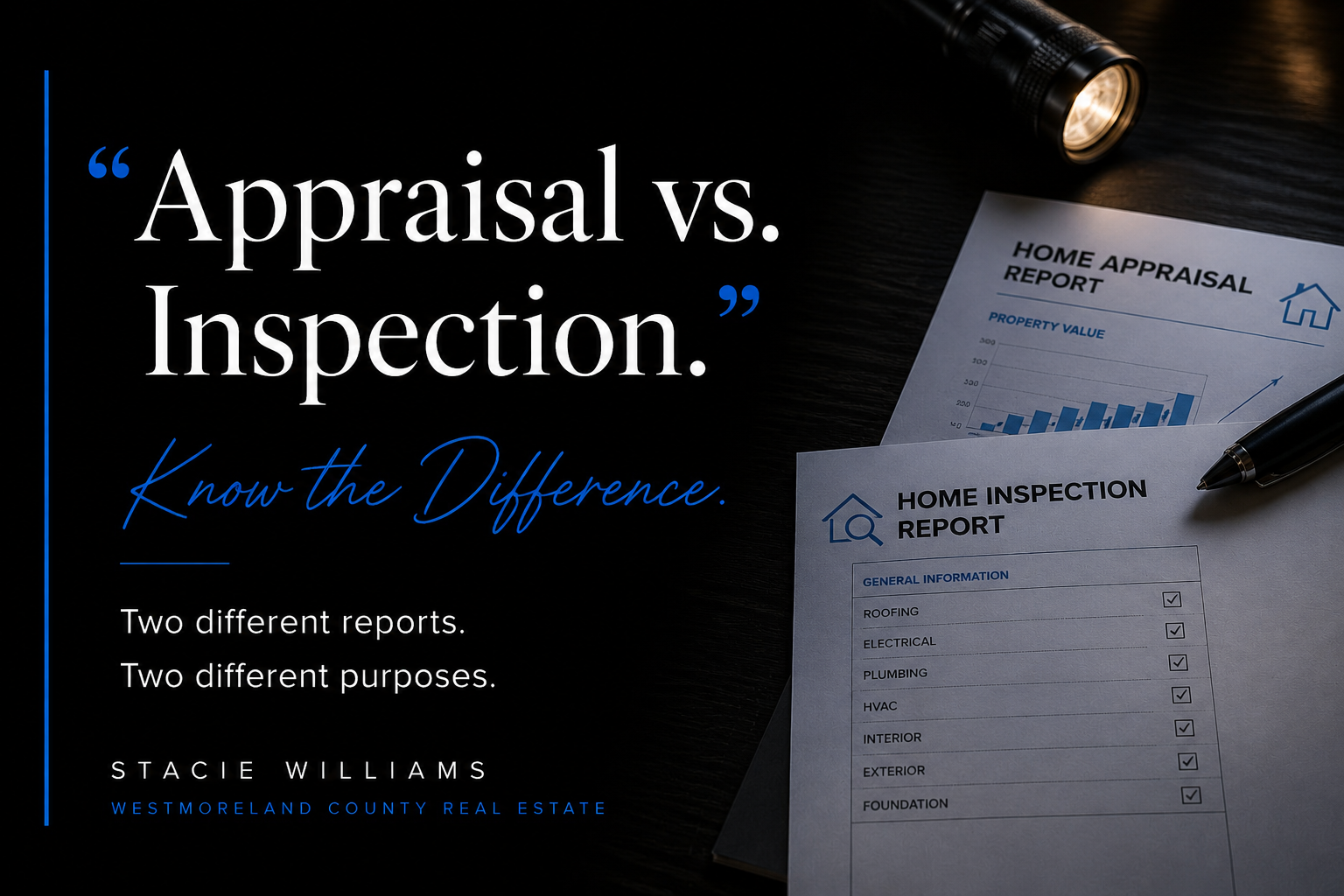
Home Appraisal vs. Home Inspection: What Buyers and Sellers Need to Know

Dated: July 21 2026

Views: 111

Home Appraisal vs. Home Inspection: What Buyers and Sellers Need to Know

A home appraisal and a home inspection often happen during the same stage of a real estate transaction, but they are not interchangeable.

One evaluates the home’s condition.

The other evaluates its market value.

Understanding the difference is important for buyers, but it is equally important for sellers. Inspection findings can lead to repair negotiations, while an appraisal can affect whether the buyer’s financing—and ultimately the sale—moves forward.

Here is what buyers and sellers in Westmoreland and Allegheny counties should understand before reaching this stage of a transaction.

What Is a Home Inspection?

A home inspection is an evaluation of the property’s visible condition and major systems.

The inspector generally examines areas such as:

  • Roof and exterior
  • Foundation and structure
  • Electrical system
  • Plumbing
  • Heating and cooling systems
  • Windows and doors
  • Attic and insulation
  • Basement or crawl space
  • Installed appliances and other accessible components

The goal is to identify defects, safety concerns, deferred maintenance and items that may need repair or replacement.

A home does not technically “pass” or “fail” an inspection. The inspector documents the property’s condition so the buyer can make an informed decision.

What the Inspection Means for Buyers

For buyers, the inspection provides a clearer picture of what they are purchasing.

Depending on the terms of the sales agreement, the results may allow the buyer to:

  • Proceed with the purchase as agreed
  • Request repairs
  • Request a credit or price adjustment
  • Obtain additional evaluations
  • Terminate the agreement when permitted by the contract

An inspection is not meant to produce a perfect house. Its purpose is to help the buyer understand the home’s present condition, potential safety concerns and future maintenance needs.

What the Inspection Means for Sellers

For sellers, the inspection period can feel unpredictable because it introduces another round of evaluation and possible negotiation.

However, sellers have more control than they may realize.

Before listing, sellers should consider addressing visible maintenance concerns, servicing major systems and making sure areas such as the attic, electrical panel, furnace and water shutoffs are accessible.

It can also be helpful to gather:

  • Receipts for major repairs
  • Roof, furnace and air-conditioning records
  • Permits or invoices for completed improvements
  • Transferable warranties
  • Maintenance documentation

This information will not eliminate every inspection concern, but it can give buyers greater confidence and help distinguish a known, maintained system from an unknown problem.

Sellers should also understand that an inspection report is not automatically a repair list. What happens next depends on the sales agreement, the seriousness of the findings and the negotiations between the parties.

What Is a Home Appraisal?

A home appraisal is an independent opinion of the property’s market value.

When a buyer is financing the purchase, the appraisal is usually ordered by the lender. The lender wants to confirm that the property provides adequate support for the amount being financed.

The appraiser may consider:

  • Recent comparable sales
  • Location
  • Square footage
  • Lot size
  • Room count and layout
  • Overall condition
  • Quality of construction
  • Updates and renovations
  • Features such as garages, finished basements or acreage
  • Current market conditions

Unlike a home inspector, the appraiser is not conducting an in-depth examination of every system in the house.

What the Appraisal Means for Buyers

For buyers, the appraisal is an important part of the financing process.

If the property appraises at or above the amount required by the lender, the transaction can generally continue through underwriting, assuming the remaining loan requirements are satisfied.

If the appraisal comes in below the agreed purchase price, the parties may need to consider several possibilities. Depending on the contract, financing and available funds, they might:

  • Renegotiate the purchase price
  • Challenge the appraisal with additional information
  • Have the buyer contribute more cash
  • Divide the difference between buyer and seller
  • Terminate the transaction when permitted

The appraisal does not guarantee that the buyer is receiving a problem-free home. It addresses value, not the complete physical condition of the property.

What the Appraisal Means for Sellers

For sellers, the appraisal can be just as important as the offer itself.

A buyer may agree to the asking price, but when financing is involved, the lender still needs the property’s value to support the loan.

This is why pricing a home correctly from the beginning matters.

An aggressive list price may generate interest, but the final sale must still be supported by market evidence unless the buyer has the ability and willingness to cover an appraisal gap.

Before the appraisal, sellers can help by making the home accessible, clean and reasonably maintained. They should also provide their real estate agent with documentation for meaningful improvements that may not be obvious during a brief visit.

Examples could include:

  • A newer roof
  • Replacement windows
  • Updated mechanical systems
  • A finished basement
  • An addition
  • Significant kitchen or bathroom renovations
  • Electrical, plumbing or structural improvements

Not every renovation produces a dollar-for-dollar increase in appraised value. However, accurate information helps ensure the appraiser has a complete picture of the property.

The Most Important Difference

The easiest way to separate the two is to look at the question each professional is answering.

The home inspector asks:

“What is the current condition of the property?”

The appraiser asks:

“What is the property worth in the current market?”

Those are two separate questions, and neither report replaces the other.

Can a Home Do Well in One and Have Problems With the Other?

Yes.

A property can be in excellent condition but appraise below the purchase price if recent comparable sales do not support the agreed value.

A property can also appraise at the contract price while the inspection uncovers substantial electrical, structural, roofing or mechanical concerns.

A transaction may therefore experience:

  • A favorable inspection and a low appraisal
  • Significant inspection concerns and an appraisal at value
  • Challenges with both
  • No major problems with either

Each process must be evaluated separately.

How Sellers Can Prepare for Both

A strong seller preparation strategy addresses both condition and value.

Before listing, sellers should consider:

  1. Completing routine maintenance and correcting visible defects.
  2. Servicing major systems when appropriate.
  3. Disclosing known material defects accurately.
  4. Organizing receipts, permits, warranties and improvement records.
  5. Making all areas of the home accessible.
  6. Pricing the property using recent, relevant market data.
  7. Preparing emotionally and financially for possible negotiations.

Sellers should not attempt to conceal defects or make cosmetic changes intended to disguise a larger issue. Transparency, preparation and accurate pricing generally create a stronger transaction than trying to avoid every possible question.

Why Online Estimates Are Not the Same as an Appraisal

Automated online estimates can be useful as a starting point, but they do not inspect the home, understand every update or evaluate the property with the same level of context as a professional appraiser.

They may not accurately account for:

  • The home’s precise condition
  • Quality of renovations
  • Unusual acreage or outbuildings
  • Differences between neighborhoods
  • Functional layout
  • Views, privacy or location influences
  • Features that are uncommon in the immediate market

For sellers, an online estimate should not replace a detailed pricing analysis based on the property and current comparable sales.

The Bottom Line

A home inspection and a home appraisal are both important, but they serve entirely different purposes.

The inspection helps the buyer understand the property’s condition.

The appraisal helps the lender and the parties understand its market value.

For sellers, preparation for both begins before the home is listed. Proper maintenance, accurate disclosures, organized improvement records and a market-supported pricing strategy can reduce surprises and strengthen the transaction from contract through closing.

Buying or Selling in Westmoreland or Allegheny County?

Every property and every transaction is different. Whether you are preparing to sell, evaluating an offer or buying a home, understanding what happens next can help you make better decisions before problems arise.

Blog author image

Stacie Williams

As a buyer or a seller, you want your real estate transactions to go smoothly. That means finding the exact home you're looking for, or selling your home promptly and for the best price. It means not ....

Latest Blog Posts

Home Appraisal vs. Home Inspection: What Buyers and Sellers Need to Know

Home Appraisal vs. Home Inspection: What Buyers and Sellers Need to KnowA home appraisal and a home inspection often happen during the same stage of a real estate transaction, but they are not

Read More

The 7 Biggest Home Inspection Myths

The 7 Biggest Home Inspection MythsPart 1: A Home Inspection Is Not Pass or FailIf you've ever bought or sold a home, you've probably heard someone say, "The house passed inspection," or "It failed

Read More

Westmoreland County Housing Market Update Summer 2026

Pennsylvania Home Prices Continue to Rise Despite Fewer SalesPublished: July 7, 2026If you've been wondering whether now is the right time to buy or sell a home in Westmoreland County, you're not

Read More

The American Dream at 250: Why Homeownership Still Matters in Westmoreland County

The American Dream at 250: Why Homeownership Still Matters in Westmoreland CountyPublished July 4, 2026As we celebrate America's 250th birthday, it's worth taking a moment to reflect on something

Read More