Home Appraisal vs. Home Inspection: What Buyers and Sellers Need to KnowA home appraisal and a home inspection often happen during the same stage of a real estate transaction, but they are not

Dated: July 10 2026
Views: 67
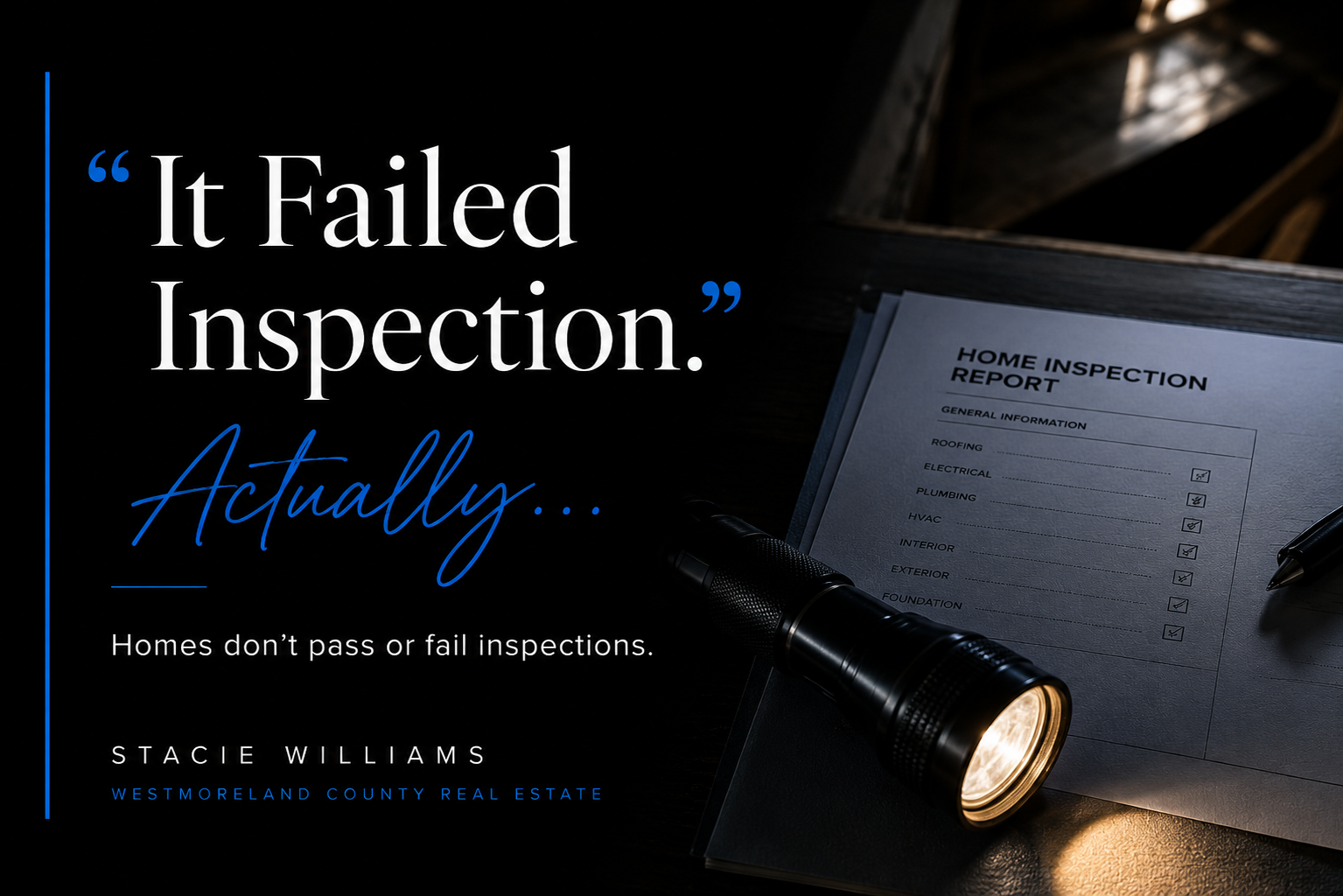
If you've ever bought or sold a home, you've probably heard someone say, "The house passed inspection," or "It failed inspection."
Here's the truth:
Homes don't pass or fail a home inspection.
It's one of the most common misconceptions in real estate, and unfortunately, it often creates unnecessary stress for buyers and sellers alike.
As an Associate Broker serving Westmoreland County and the greater Pittsburgh region, I've guided hundreds of buyers and sellers through the inspection process. One of the first things I explain is that a home inspection is an educational tool—not a grading system.
A professional home inspection is a visual evaluation of a property's readily accessible systems and components at the time of the inspection.
The inspector documents the home's observable condition and notes items that may require maintenance, repair, replacement, or further evaluation by a qualified professional.
The inspection report is designed to provide information—not approval or rejection.
Think of it as a snapshot of the home's condition on the day it was inspected.
One of the biggest surprises for first-time buyers is learning that every home will have findings.
Even a newly constructed home will typically generate a detailed inspection report.
Inspectors commonly identify:
Routine maintenance items
Minor cosmetic concerns
Safety observations
Deferred maintenance
Components approaching the end of their expected service life
Recommendations for monitoring or further evaluation
Finding items in an inspection report doesn't automatically mean there's something "wrong" with the home.
Many of the observations are simply part of owning and maintaining a home over time.
Once the inspection is complete, buyers review the report and determine how they would like to proceed, subject to the terms of their purchase agreement.
Depending on the findings, several outcomes are possible:
The buyer accepts the property as-is.
The buyer requests repairs.
The buyer requests a credit toward closing costs.
The buyer and seller negotiate another solution.
In situations permitted by the purchase agreement, the buyer may choose to terminate the transaction.
Every real estate transaction is unique. The inspection contingency exists to allow both parties the opportunity to negotiate in good faith based on the home's condition.
Don't panic if the inspection report is lengthy.
It's completely normal.
A 40-, 60-, or even 100-page report doesn't necessarily indicate major problems. Today's inspection software includes extensive photographs, maintenance recommendations, explanations, and documentation that naturally make reports much longer than they were years ago.
Rather than focusing on the number of pages, pay attention to the significance of the findings.
Most buyers understand that no home—whether it's five years old or fifty years old—is perfect.
Remember that the purpose of a home inspection isn't to find a perfect house.
The goal is to understand the condition of the property you're purchasing so you can make informed decisions before closing.
An experienced real estate professional can help you distinguish between routine maintenance items, recommended future repairs, and issues that deserve additional attention or negotiation.
The phrase "passed inspection" is one of the biggest myths in real estate.
A home inspection doesn't assign a grade, and it doesn't determine whether a transaction should move forward.
Instead, it provides valuable information that helps buyers and sellers make informed decisions, understand the condition of the property, and negotiate when appropriate.
Knowledge—not fear—is what makes the inspection process successful.
This article is the first installment in my 7 Biggest Home Inspection Myths educational series.
Future articles will explore additional misconceptions about home inspections, including seller repair requests, new construction inspections, "as-is" sales, and more—helping buyers and sellers better understand one of the most important steps in a real estate transaction.
If you're preparing to buy or sell a home and have questions about the inspection process, I'd be happy to help you understand what to expect and navigate the process with confidence.

As a buyer or a seller, you want your real estate transactions to go smoothly. That means finding the exact home you're looking for, or selling your home promptly and for the best price. It means not ....
Home Appraisal vs. Home Inspection: What Buyers and Sellers Need to KnowA home appraisal and a home inspection often happen during the same stage of a real estate transaction, but they are not
The 7 Biggest Home Inspection MythsPart 1: A Home Inspection Is Not Pass or FailIf you've ever bought or sold a home, you've probably heard someone say, "The house passed inspection," or "It failed
Pennsylvania Home Prices Continue to Rise Despite Fewer SalesPublished: July 7, 2026If you've been wondering whether now is the right time to buy or sell a home in Westmoreland County, you're not
The American Dream at 250: Why Homeownership Still Matters in Westmoreland CountyPublished July 4, 2026As we celebrate America's 250th birthday, it's worth taking a moment to reflect on something
 West Penn MLS, Inc. All information deemed reliable but not guaranteed. All properties are subject to prior sale, change or withdrawal. Neither listing broker(s) or information provider(s) shall be responsible for any typographical errors, misinformation, misprints and shall be held totally harmless. Listing(s) information is provided for consumer's personal, non-commercial use and may not be used for any purpose other than to identify prospective properties consumers may be interested in purchasing.
The data relating to real estate for sale on this website comes in part from the Internet Data Exchange program of the Multiple Listing Service. Real estate listings held by brokerage firms other than The Stacie Williams and Aimee Berardi Team may be marked with the Internet Data Exchange logo and detailed information about those properties will include the name of the listing broker(s) when required by the MLS. Copyright ©2026 All rights reserved.
Last Updated: September 26, 2026 9:58 AM UTC
Show More...
West Penn MLS, Inc. All information deemed reliable but not guaranteed. All properties are subject to prior sale, change or withdrawal. Neither listing broker(s) or information provider(s) shall be responsible for any typographical errors, misinformation, misprints and shall be held totally harmless. Listing(s) information is provided for consumer's personal, non-commercial use and may not be used for any purpose other than to identify prospective properties consumers may be interested in purchasing.
The data relating to real estate for sale on this website comes in part from the Internet Data Exchange program of the Multiple Listing Service. Real estate listings held by brokerage firms other than The Stacie Williams and Aimee Berardi Team may be marked with the Internet Data Exchange logo and detailed information about those properties will include the name of the listing broker(s) when required by the MLS. Copyright ©2026 All rights reserved.
Last Updated: September 26, 2026 9:58 AM UTC
Show More...
